
Table of Contents
Renovating a villa in Dubai in 2026 is no longer a cosmetic exercise. It is a design-led, regulation-heavy, capital-intensive project that sits somewhere between building a new home and curating a lifestyle. In prime communities such as Palm Jumeirah, Emirates Hills, Dubai Hills Estate, Jumeirah Golf Estates, and Arabian Ranches, a well-executed villa renovation now adds between 15 percent and 25 percent to resale value, and in ultra-prime Palm frond villas, margins can exceed AED 5 million on a successful flip.
The catch? That upside only materialises when you pick the right villa renovation company. Choose poorly and you inherit delays, stop-work orders, cost overruns, and finishes that look dated within a year. This guide walks premium homeowners through exactly how to choose the best villa renovation company in Dubai, what to look for in 2026, what to avoid, and how pricing actually works today.
Why this decision is harder in 2026 than it was five years ago
A few things have changed. Dubai Municipality has moved renovation approvals onto a fully digital, AI-assisted BPS system, which means simple cosmetic permits can now be cleared in 48 hours but structural work still requires architectural drawings, MEP drawings, structural calculations, and a registered consultant. Fines for unapproved structural work now start at AED 10,000 and can reach AED 100,000 for serious breaches, and unpermitted modifications are flagged by the Dubai Land Department at the point of sale.
At the same time, Al Sa’fat 2.0 is the mandatory baseline sustainability rating for new and significantly altered buildings in Dubai, which means any serious villa renovation now has to hit 20 percent energy savings, use low VOC materials, and integrate water efficient fixtures. Palm Jumeirah, Emirates Hills, and waterfront properties face even stricter cycles because of Nakheel, Trakhees, and marine structural requirements.
The practical effect is simple. The gap between a competent villa renovation company in Dubai and an opportunistic contractor has widened. In 2026, that gap costs real money.
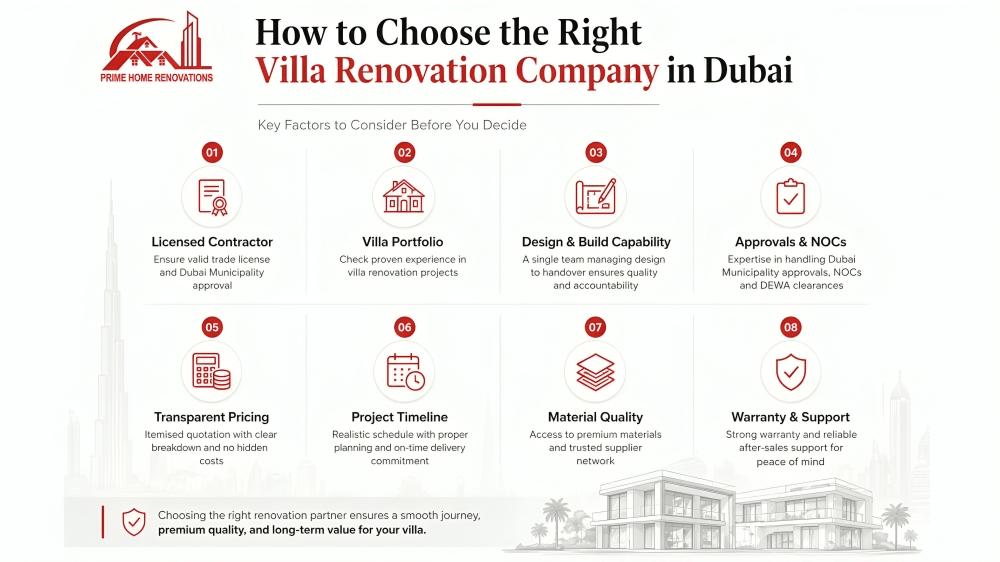
Ten criteria to evaluate the best villa renovation company in Dubai
Use this as a checklist before you shortlist anyone. A premium villa project should satisfy all ten points, not eight.
1. Verified licensing and trade authorisation
The first filter is boring but non-negotiable. The company must hold a valid DED trade licence that covers building contracting, interior decoration, and renovation. For structural work, the contractor should either employ or sub-contract a registered consultant who can submit drawings through the Dubai BPS portal. If the company cannot produce a trade licence number, walk away. Only municipality-approved contractors can legally submit permit applications in Dubai.
2. A villa-specific portfolio, not a generic fit-out catalogue
Apartment fit-outs and villa renovations are different disciplines. Villas involve private MEP systems, older AC ducting, landscaping, external facades, pools, and sometimes structural reconfiguration across two or three floors. Ask to see at least five completed villa projects in the last 24 months, ideally in the same community as yours. A contractor who has finished 10 full villa makeovers in Arabian Ranches will outperform one with 200 apartment projects and three villas.
You can see a few recent examples on our villa renovation projects page, including a full villa upgrade in Mudon and an interior and kitchen renovation in Arabian Ranches.
3. A genuine design and build capability
Premium renovations go wrong at the handover line between designer and contractor. The best villa renovation companies in Dubai now operate under a single contract, so one team is accountable for 3D design, material selection, joinery, MEP, execution, and handover. Ask the question directly: who owns the design intent, and who owns the finish quality? If the answer involves three different parties blaming each other, your project is already compromised.
4. Mastery of Dubai Municipality approvals, NOCs, and DEWA clearances
In 2026, the approval stack for a typical villa renovation looks like this: a developer NOC from Emaar, Nakheel, Meraas, or DAMAC, a Dubai Municipality building permit via the BPS portal (or Trakhees for Palm Jumeirah and JAFZA, or DDA for free zone areas), a DEWA clearance for any electrical or plumbing modification, and in some cases a Civil Defence NOC for fire safety changes.
Typical villa approval timelines run four to six weeks for structural work, and permit fees sit between AED 5,000 and AED 15,000. A good contractor handles all of this in-house. A weak one hands you forms and hopes you figure it out. For homeowners who want to understand the official framework, the Dubai Municipality portal is the authoritative source.
5. Transparent, itemised quotations with no scope creep
Ask every shortlisted company for a line-item quotation. It should split costs across demolition, MEP, civil works, joinery, flooring, sanitary, kitchen, bathroom, painting, landscaping, permits, project management fees, and contingency. Any quote that gives you one round number for “villa renovation AED 850,000” is hiding something. Premium homeowners in 2026 should also insist on a 10 to 15 percent contingency buffer, which is now standard in Dubai construction contracts.
6. Access to premium materials and a serious vendor network
A luxury renovation lives or dies by finishes. Italian marble slabs, floor-to-ceiling pivot doors, bespoke joinery, German sanitary ware, Japanese smart toilets, hand-knotted rugs, and bookmatched stone are not available from the first supplier in Al Quoz. The right company has direct relationships with premium suppliers and can guide you on lead times, which for European imports now run eight to twelve weeks. Start appliance and joinery selection before civil works begin or you will sit on a finished shell waiting for cabinets.
7. Project management and timeline discipline
A standard Dubai Hills villa renovation takes six to nine months. A Palm Jumeirah villa renovation takes nine to fourteen months. Anyone promising a luxury full-villa transformation in twelve weeks is either lying or cutting corners. Ask for a sample Gantt chart from a recent project, a named project manager, a weekly reporting cadence, and a penalty clause for unjustified delays. Good companies welcome this. Evasive ones do not.
8. Smart home, MEP, and sustainability expertise
Luxury in 2026 means control. Lighting scenes, automated shading, zoned climate, integrated audio, Matter-compatible ecosystems, solar tie-ins, EV chargers, and water efficient fixtures are now baseline expectations in prime Dubai communities. Your renovation partner should have an in-house low voltage team or a pre-integrated smart home partner, not a last-minute electrician figuring out KNX on site. Work that ties into DEWA for additional load, particularly for pool chillers, home servers, and EV charging, can add AED 45,000 or more in connection fees alone, so plan this early.
The same logic applies across electrical, plumbing, and waterproofing trades. These are the silent trades that decide whether your villa ages well.
9. Community specific experience
Every prime community has its own rules. Emaar NOCs typically process in three to five business days. Nakheel cycles on Palm Jumeirah take longer and require structural stability reports. Jumeirah Golf Estates, Dubai Hills, Damac Hills, Victory Heights, and The Villa each have community specific finish standards and construction windows. A company that has worked in your community before will save you weeks of back and forth.
10. Warranty, insurance, and post-handover support
Minimum acceptable cover in 2026 is a one year workmanship warranty on all trades, up to ten years on joinery, and separate manufacturer warranties on appliances and sanitary ware. Also confirm that the company carries contractor all risk and third party liability insurance for the project. Premium buyers should also ask about the snagging and defects liability process, because the first six weeks after handover are where small issues surface.
Five red flags that should end the conversation
- No trade licence number, or reluctance to share it in writing
- Round-number quotations without itemised scope
- Unrealistic timelines (“we can do the whole villa in eight weeks”)
- Cash-only or large up-front payment demands above 20 percent
- No previous projects in your community, or testimonials that cannot be verified on Google, Houzz, or Bayut reviews
If any of these appear, there is always another option. Bayut’s Dubai property renovation process guide is a useful second reference for homeowners who want to cross-check standard practice.
Ten questions to ask before you sign
- Can you share your DED trade licence and project references in my community?
- Who will be my dedicated project manager, and how often will we meet?
- Will design, approvals, execution, and handover sit under one contract?
- What is the payment schedule, and how is it tied to milestones?
- What is included in your itemised quotation, and what is excluded?
- How do you handle variations and scope changes once work has started?
- Which suppliers will you use, and can I see samples before approval?
- What is your warranty on workmanship, joinery, and MEP?
- How will you handle Dubai Municipality, developer NOC, and DEWA clearances?
- What is your snagging and defects liability process after handover?
A premium contractor will answer all ten without hesitation. If any answer is vague, that is your data point.
How Prime Home Renovations approaches premium villa projects in Dubai
Prime Home Renovations LLC is a Dubai based design and build firm specialising in villa and apartment transformations. Our work spans full villa makeovers, luxury kitchen renovations, spa grade bathroom upgrades, marble and parquet flooring, decorative ceiling works, and outdoor and landscape transformations.
Every project runs through a four stage process: a free site visit and consultation, a design and materials phase with a fully itemised quotation, approvals and supervised execution, and a detailed snagging inspection before handover. One team, one contract, one point of accountability. Read more about our approach or request a free consultation to discuss your villa.
Ready to start your villa renovation?
Choosing the best villa renovation company in Dubai comes down to licensing, portfolio depth, design and build capability, approval expertise, and transparent pricing. Get those five right and the rest of the project gets easier.
If you are planning a villa renovation in Dubai in 2026, book a free consultation with Prime Home Renovations and we will walk you through a realistic timeline, cost benchmark, and design direction for your home.
Frequently asked questions
How long does a full villa renovation take in Dubai in 2026?
A mid-range villa renovation typically takes three to four months. A premium full villa transformation in Dubai Hills runs six to nine months. Palm Jumeirah and Emirates Hills projects usually take nine to fourteen months because of stricter approvals and waterfront complexity.
Do I need Dubai Municipality approval for a villa renovation?
Yes, for any structural change, MEP modification, wall removal, villa extension, pool construction, or changes to the building footprint. Cosmetic work such as painting, fixture replacement, or cabinet refacing usually does not require DM approval, but your master developer may still require notification. Permit fees for a typical villa run AED 5,000 to AED 15,000.
What happens if I renovate without approval?
Fines start at AED 10,000 and can reach AED 100,000. Authorities can issue stop-work orders and require forced restoration. Unapproved modifications are also flagged by the Dubai Land Department at the point of sale, which can block a transaction or force you to regularise the work.
How much does a luxury villa renovation cost in Dubai in 2026?
Luxury villa renovation pricing in 2026 ranges from AED 1,000 per square foot in Dubai Hills to AED 2,500 plus per square foot on Palm Jumeirah for ultra-luxury bespoke work. A full villa renovation in a premium community typically starts at AED 1.8 million and can exceed AED 15 million on the Palm.
Is it worth renovating an older villa instead of buying new?
In most cases, yes. Renovating a secondary villa is roughly 15 to 20 percent cheaper per square foot than buying new, and a well-executed renovation in Dubai Hills can lift resale value by 15 to 25 percent. On Palm Jumeirah, the upside is often larger but so is the holding cost during the renovation window.
Should design and construction be under one contract or separate?
For premium villas, a single design and build contract is almost always the better choice. It removes the finger-pointing between designer and contractor, tightens accountability, and keeps the original design intent intact through execution.
What is Al Sa’fat compliance and does it apply to my renovation?
Al Sa’fat 2.0 is Dubai’s mandatory baseline sustainability rating. It focuses on 20 percent energy savings, water efficient fixtures, and low VOC materials. It applies to new buildings and to significantly altered existing buildings, which covers most full villa renovations.
How do I verify a villa renovation company is legitimate?
Ask for the DED trade licence number, check the company’s project portfolio in person where possible, request references from clients in your community, review Google and Bayut ratings, and confirm they carry contractor all risk and third party liability insurance.
What is the best way to start a villa renovation in Dubai?
Begin with a free site visit from a shortlist of two or three companies. Compare itemised quotations on the same scope, not just total figures. Finalise design and materials before breaking ground, and insist on a clear payment schedule tied to milestones.